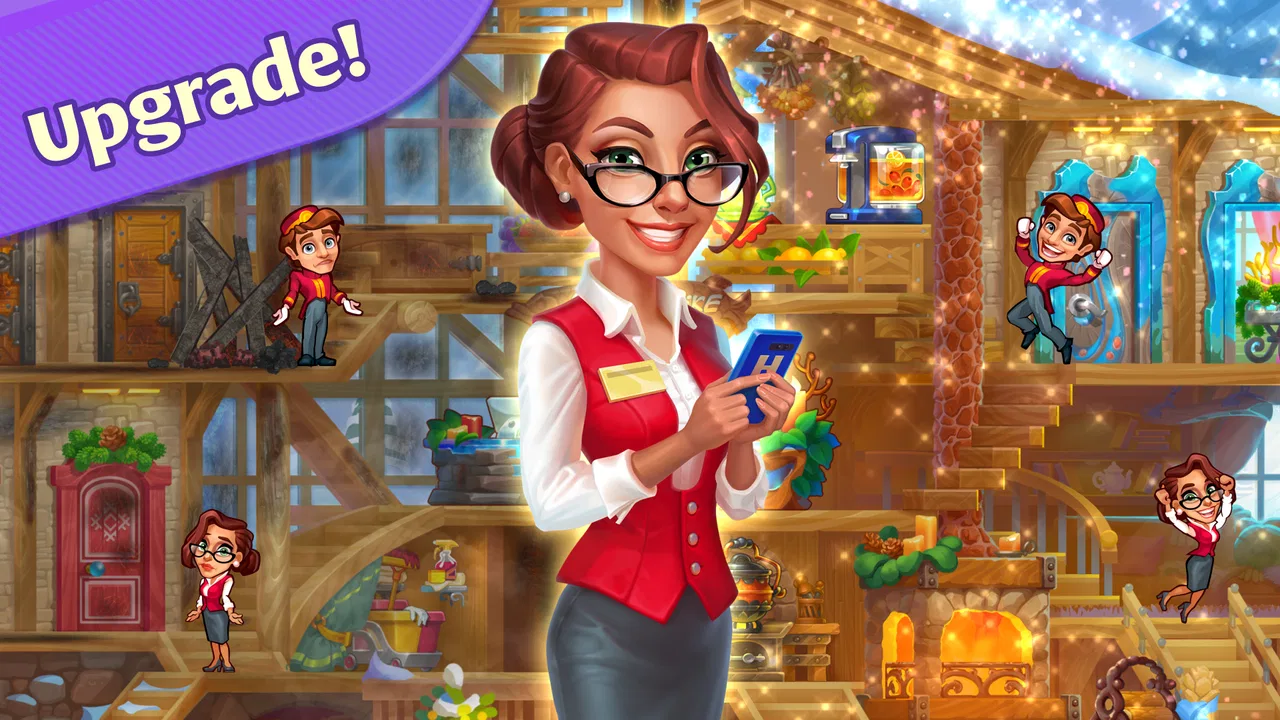
Grand Hotel Mania: Hotel games
- 4.4
- Rating
- 10.00M
- Installs
- Free
- Price

 Analysis by App-foxy
Grand Hotel Mania: Hotel games is the kind of arcade management game that makes a short break feel surprisingly busy. I started with the simple idea of serving guests, keeping rooms moving, and improving the hotel, but the appeal quickly became more about rhythm: noticing what needs attention first, making a fast choice, and recovering when several demands arrive together. It is free to play, developed by DeusCraft, and its Everyone rating makes it approachable for a broad audience.
What matters to me with a game like this is not whether the opening session is entertaining. Most time-management games can manage that. The real question is whether the routine remains enjoyable after the first rush of novelty disappears. In this case, the answer is mixed but positive. The first week is easy to recommend, while the longer-term experience depends heavily on how comfortable you are with repetition, progression pressure, and optional spending.
From quick hotel tasks to a daily routine
I find the game works best when I treat it as a flexible pocket activity rather than a daily obligation. In this section, I’ll look at how its quick hotel tasks can fit into ordinary breaks, and what helps keep those sessions satisfying instead of routine. The key is noticing when a short burst of focused play is welcome—and when a calmer option would suit me better.
You May Also Like

 Blood Strike: 2.5 Anniversary
Blood Strike’s Loadouts Turn Every Drop Into a Tactical Gamble
A close look at Blood Strike’s custom loadouts: how fast access to signature weapons reshapes its battle royale rhythm, rewards preparation, and narrows the gap between fights.

 Pandora - Music & Podcasts
Pandora’s Music Is Easy to Start, but Harder to Recover
Pandora’s strength is its low-effort path from a seed to a station. Its weak spot is how much confidence it asks you to place in connection, setup, and quiet recovery.

 8 Ball Pool
 Is Built on Rivalries, Rematches, and Routine
A close look at the rivalries, rematches, shared routines, and unanswered safety questions that turn a quick pool match into a persistent mobile community.

 Samsung Music
’s Quiet Strength Is Playing What You Already Own
Its reach comes less from spectacle than from dependable access to a personal library. That simplicity is both the app’s strongest retention engine and its ceiling.

 AccuWeather: Weather Radar
AccuWeather Review: A Quick, Clear Forecast for Everyday Decisions
For everyday plans, the best forecast is the one you can understand quickly. AccuWeather makes rain timing, radar, and local conditions easy to act on, with a few trade-offs.

 Hill Climb Racing
Why Hill Climb Racing Still Turns Crashes Into One More Run
A tiny car, a bumpy hill and one more upgrade: Hill Climb Racing keeps resurfacing because its simple chaos makes every near-miss feel personal.
More From Our News Desk



The first sessions are easy to understand
The central loop is immediately readable. Guests need attention, hotel operations have to be handled in the right order, and timing affects how smoothly each level goes. I never felt lost about what the game wanted me to do. That clarity is one of its strongest qualities because it lets the challenge come from prioritizing tasks rather than learning complicated controls.
It works particularly well on a phone. I can play with one hand, finish a short sequence, and put the device away without needing to remember a complicated control scheme. The arcade presentation gives each action a pleasing sense of urgency, but the game remains more about planning than reflexes. You are not simply tapping as quickly as possible; you are deciding which small problem deserves attention before it becomes a larger one.
During the first week, the steady stream of objectives gives the game a useful feeling of momentum. Completing a hotel task leads naturally into the next one, and improvements make the early progress feel visible. This is where the “hotel tycoon” idea works best: I am not only serving individual visitors, but also watching a small operation become more capable over time.
Why the opening feels stronger than the store summary
The short description presents a hotel simulator, but that does not fully explain the hands-on nature of the experience. This is not a quiet decorating game where I can slowly arrange a perfect lobby. It is closer to an arcade service challenge, with attention divided between immediate guest needs and the broader goal of improving performance.
That distinction matters when choosing it over other management games. If you want relaxed building, creative customization, or a simulation that runs mostly at your own pace, this may feel too active. If you enjoy the satisfaction of turning a messy sequence of small requests into a clean routine, the design is much more appealing.
I also like that the game creates natural moments of tension without requiring advanced gaming skills. A level can begin calmly, then become difficult because several jobs overlap. The most useful habit is to look a step ahead instead of reacting to the loudest request on screen. I found that planning the next action while completing the current one was more valuable than simply tapping faster.
A realistic everyday use case
For me, the best setting is a short waiting period: a commute break, a few minutes before an appointment, or the end of a workday when I want something active but not mentally heavy. One session can provide a clear beginning and end, which makes it easier to stop than a large open-ended game.
There is a small catch. The game’s urgency can be less relaxing than expected. After a demanding day, I sometimes wanted a calm hotel builder and instead found myself concentrating on queues and timing. That is not a flaw in execution; it is a mismatch between mood and genre. I would choose this over a puzzle game when I want quick decisions, but not when I need something genuinely soothing.
What improves with regular play
After the first few days, the main pleasure comes from becoming more efficient. I began to recognize patterns in the order of tasks and stopped treating every request as an isolated emergency. That learning curve is a genuine strength. The game rewards familiarity, so returning after a break does not feel like starting from zero.
A useful approach is to treat each level as a workflow exercise. Instead of chasing every immediate reward, I try to identify the actions that keep the whole hotel moving. This reduces wasted movement and makes later stages feel less chaotic. It is one of the less obvious reasons the game can hold attention: improvement comes partly from upgrades, but also from improving my own decisions.
The current version is 4.17.9.0, and the game has built a substantial audience, with over 10 million installs. Its average rating is 4.4 from around 204 thousand ratings, which fits my impression that the basic loop is broadly accessible even though the long-term model will not suit everyone.
Does it still have value after the opening novelty?
Month-to-month value depends on what you expect from a mobile game. I do not see this as a title that I would play continuously for hours every day. Its better role is a repeatable short-session game. The appeal comes from returning, handling a few rounds, and trying to perform more cleanly than before.
That can be enough for someone who likes routine. The hotel theme gives the repeated tasks a little more personality than an abstract sorting game, while the arcade structure keeps progress understandable. I can see why players would make it part of a daily gaming habit, especially if they enjoy gradually improving a familiar process.
However, the game does not completely escape the limits of its format. Once the basic actions are familiar, the experience can feel like variations on the same service pattern. New situations may change the pressure, but the underlying mental rhythm remains recognizable. If you need constant mechanical surprises, this is unlikely to stay fresh indefinitely.
Where optional purchases affect the experience
The game is free to download and includes in-app purchases ranging from $0.33 to $99.99 per item. I appreciate being able to try the core experience without paying upfront, but anyone who dislikes mobile progression systems should approach it carefully. The important question is not whether the opening is free; it is whether you are comfortable continuing without treating purchases as a shortcut.
My advice is to decide early what kind of player you want to be. If you are happy to play at the game’s natural pace, the free entry point makes sense. If you become frustrated whenever progress slows and feel tempted to buy your way past that feeling, the model may turn the game from a pleasant routine into an irritating obligation.
This is also where it differs from a traditional paid arcade game. A paid alternative may offer a more fixed experience with fewer reasons to return, while this game is designed around continued progression. That continuing structure can be motivating, but it also means the player has to manage expectations about time and spending.
The real maintenance burden
The maintenance burden is not technical in the sense of managing a complicated system. It is behavioral. To get lasting value, I need to return often enough to remember the flow of play, but not so often that every session feels like work. The game is easiest to enjoy when it remains a choice rather than a duty.
For that reason, I would not recommend forcing a daily streak if the routine stops being fun. A better method is to use it as a flexible pocket game: play when I want a few focused minutes, then leave it alone. Because the controls are straightforward, coming back after a short absence is manageable, but long breaks can make the first session feel slightly less fluid while I rebuild my timing.
Another practical tip is to avoid judging a session only by its final result. I get more value when I pay attention to why a sequence went badly. Was I reacting too late, choosing the wrong priority, or trying to handle too many things at once? That kind of review turns repetition into practice rather than empty grinding.
Who should skip it
I would skip Grand Hotel Mania: Hotel games if I wanted a deep economic simulation, extensive interior design, or a slow sandbox with no pressure. The hotel setting may suggest those possibilities, but the actual focus is fast service management. Players who dislike timers, repeated objectives, or free-to-play progression are also likely to become frustrated before the longer-term strengths have a chance to appear.
I would also be cautious about recommending it to someone who wants a game that can be played entirely passively. The fun comes from paying attention. If I look away too often, the carefully ordered workflow breaks down, and the game loses much of its appeal.
Who gets the most from it
It is a strong match for players who enjoy arcade games with a management flavor, especially those who like improving through repetition. It is also suitable for people who want something more structured than an endless runner but less demanding than a full strategy game. The Everyone age rating makes it easy to suggest across a wide range of players, although personal tolerance for pressure matters more than age here.
One of the best advanced habits is to separate speed from efficiency. Tapping rapidly can feel productive, but a rushed choice often creates extra work later. I had better results when I kept a stable order of operations and only accelerated when I knew the next step. That is a small distinction, but it changes the game from frantic clicking into a more satisfying planning challenge.
How it compares with familiar alternatives
Compared with an endless runner, this game offers more control over the outcome. Success is not mainly about reacting to obstacles; it is about organizing several demands. Compared with a match-three arcade game, it has less emphasis on finding combinations and more emphasis on maintaining a sequence. Compared with a traditional tycoon game, it is faster, more hands-on, and less interested in giving the player a broad economic overview.
Those comparisons explain both its appeal and its limits. It occupies a useful middle ground, but it does not replace any of those genres completely. I would choose it when I want a hotel-themed task game with visible progression. I would choose a calmer builder for creativity, a puzzle game for pure problem-solving, and a deeper strategy title for long planning sessions.
The long-term verdict
After the novelty fades, the game earns a place on my phone only if I accept its repetitive rhythm. The hotel theme is inviting, the controls are approachable, and the short-session structure is convenient. More importantly, the game gives me room to improve my own workflow, which adds a layer of satisfaction beyond simply unlocking the next part of the experience.
Its weaknesses are equally clear. The repeated service loop can become familiar, the pressure is not always relaxing, and the free-to-play structure may test the patience of players who want a completely predictable progression path. Those are not minor details; they determine whether the game becomes a regular habit or a brief experiment.
My recommendation is therefore specific: try it if you enjoy arcade time management and want a hotel game built around quick decisions rather than decoration alone. Give it a fair chance over several short sessions, but keep your expectations realistic about repetition and optional purchases. I would not call it a forever game for every player, yet it has enough polish in its central routine to remain useful as a dependable pick-up-and-play title.
DeusCraft has made something that works best in modest doses. I can imagine opening it for a focused break, improving a familiar sequence, and stopping before the routine becomes tiring. That balance is the reason I would recommend it to a friend: the lasting value comes from mastering the flow, not from endlessly chasing novelty. For the right player, that is enough to keep this free arcade game in regular rotation.
FAQs for Grand Hotel Mania: Hotel games
01What is the main objective of Grand Hotel Mania: Hotel Games?
Grand Hotel Mania: Hotel Games is a time-management simulation where players assume the role of a hotel manager. The primary objective is to serve guests efficiently, manage hotel operations, and upgrade facilities to create a world-class hospitality experience. Players must balance speed and strategy to succeed in various challenging levels.
02Are there in-app purchases in Grand Hotel Mania?
Yes, Grand Hotel Mania offers in-app purchases. Players can buy coins and gems to expedite progress, unlock premium features, or enhance hotel amenities. While the game is free to download, these purchases can enhance gameplay but are not mandatory to enjoy the game fully.
03Is an internet connection required to play Grand Hotel Mania?
An internet connection is required to access certain features in Grand Hotel Mania, such as leaderboards and special events. However, the core gameplay can be enjoyed offline, allowing players to manage their hotels and complete levels without an active internet connection.
04What platforms is Grand Hotel Mania available on?
Grand Hotel Mania is available on both Android and iOS platforms. Users can download the app from Google Play Store for Android devices or the Apple App Store for iOS devices. It is optimized to run smoothly on a wide range of devices, ensuring an enjoyable gaming experience.
05How does the game handle difficulty progression?
Grand Hotel Mania gradually increases in difficulty as players advance through levels. Early stages serve as tutorials, introducing basic mechanics. As players progress, they encounter more demanding challenges, requiring quicker decision-making and strategic upgrades. This progression keeps the gameplay engaging and tests players' management skills.
Pros
- Engaging storyline with diverse characters.
- Challenging levels that keep you hooked.
- Regular updates with new content.
- Visually appealing graphics and design.
- Easy to learn for beginners.
Cons
- In-app purchases can be costly.
- Requires internet connection to play.
- Ads can be frequent and intrusive.
- Energy system limits playtime.
- Progression can feel slow without spending.

Grand Hotel Mania: Hotel games
Gallery